

Solving the AI Power Problem
Hating data centers won't cut it. And what to do if you're feeling despair now.

We are not made to watch state-sponsored executions on our phones and act like everything is ok.
If you’re in America feeling horrified right now, you’re not alone. That despair is the rational result of being human and the sacred social contract we have with one another. There are many more of us than there are those who celebrate violence against the most vulnerable. They are a loud minority with no plan to make housing or healthcare or energy prices better, and history teaches us their Scorched Earth strategy will only alchemize stronger resistance.
Did you ever wonder as a kid what you would have done in the Civil Rights era? Would you have organized, spoke up, boycotted, marched, or put your body in harm’s way like Alex Pretti?
Inhumane violence will lose; the question is when. It’s not too late to start. There are many ways to build the world we want, so I’m sharing a few resources in case they’re as helpful to you.
Call Congress and urge them to stop new funding for ICE and demand accountability:
I know, you’re always being told to call Congress. It matters now because we’re in an election year and are approaching a Jan 30 deadline to avoid a partial government shutdown. The Senate is expected to vote as early as Monday or Tuesday on legislation to fund the Department of Homeland Security and ICE. Use the app 5calls, which makes it easy to leave messages. I did it in 5 min.
Use iceout.org to get alerts in your neighborhood and report what you see.
This is a community-driven tracker of ICE activity. It will help you keep your neighbors safe now, but it also will help document violence as it unfolds.
Support the brave organizers on the frontlines.
Support MN organizations that need financial support.
Contact the office of MN Gov Tim Walz and call for an eviction moratorium for the next seven days, minimizing increased exposure to ICE for vulnerable residences. 651-201-3400; IG: @MNGovernor; TWITTER: @GovTimWalz; Tim.walz@State.mn.us.
Build community locally.
Here is a list of local organizations that focus on immigrant support and advocacy.
Here’s a list of mutual aid organizations across the U.S.
It might not seem like it now, but when enough of us do these things, humanity will win.
This is a picture of my favorite moment recently: my immigrant aunties seeing the Statue of Liberty for the first time. There are so many good people in America holding their breath. May this horror make us care more and act differently.

Solving the AI Power Problem
I was already working on a series called “Solving the AI Power Problem” in late December when the Guardian ran a story about 200+ environmental nonprofits that sent a letter to Congress demanding the halting of data center construction until regulations were imposed.
There is good reason for alarm. Countless news stories have covered the fact that massive data centers are so power and water hungry that they can topple local ecosystems. The massive scale of new data centers is hard to comprehend, and More Perfect Union documentaries feature important journalism on the horrific human impact of poorly-designed data centers.
I read the 200+ environmental nonprofit missive to see what regulations these nonprofits suggested, and I couldn’t believe it: the letter did not contain a single policy or innovation recommendation.
This guaranteed the letter would be dismissed by busy Congressional staffers, many of which are underpaid twenty-somethings trying to survive each day. Similarly, More Perfect Union’s excellent documentaries advocate for stopping the building of data centers without suggesting viable solutions for building them.
This is a losing strategy.
We aren’t going to put the AI genie back in the bottle, and we’re missing the opportunity to accelerate the systemic solutions that can fix the problem.
I learned this working with Congress and the federal government. The vast majority of laws are not actually written by elected officials; they’re drafted by think tanks and interest groups and handed to overstretched policymakers. The one who volunteers to take the pen ends up disproportionately shaping the future.
Congressional staffers don’t have time to be experts on large energy loads, transmission, and modernizing the grid. They’re also hearing from developers and investors who are proposing data center buildout and promising to bring infrastructure investment to neglected rural areas.
If we don’t acknowledge the tensions and suggest a better path forward, we cede the outcomes we want.
“Solving the AI Power Problem” is a short-form video series simplifying how we can get started.
Can we build data centers to use less power and water? How do we scale onsite clean energy generation and storage? Can AI actually help modernize the grid?
Here are the first principles informing my analysis.
Data centers:
Should not deplete and ruin local community water supply
Should not drive local residential electricity bills to go up
Should strengthen the grid and make it cleaner, cheaper, and more reliable
Should provide benefits to the local community
I offer this series from a pragmatic and optimistic perspective. I hate AI slop, but I love that my Korean aunties can use AI to translate information only available in English. I believe we are grossly underestimating the mass layoffs that come from AI, and I wish AI would do my dishes and laundry instead of replacing artists and writers. I don’t need AI to improve the quality of my life, yet I love that it has exponentially accelerated cancer research, methane detection, and materials science innovations in fusion energy.
I believe a better future is ours to mold, and the hard work lies in illuminating the path and collectively building towards it.
Even as data center backlash increases, polling from Pew and Navigator suggest there are nearly as many Americans that are pro-data centers as there are people who are anti-data centers. Most importantly, the greatest number of people are still undecided.
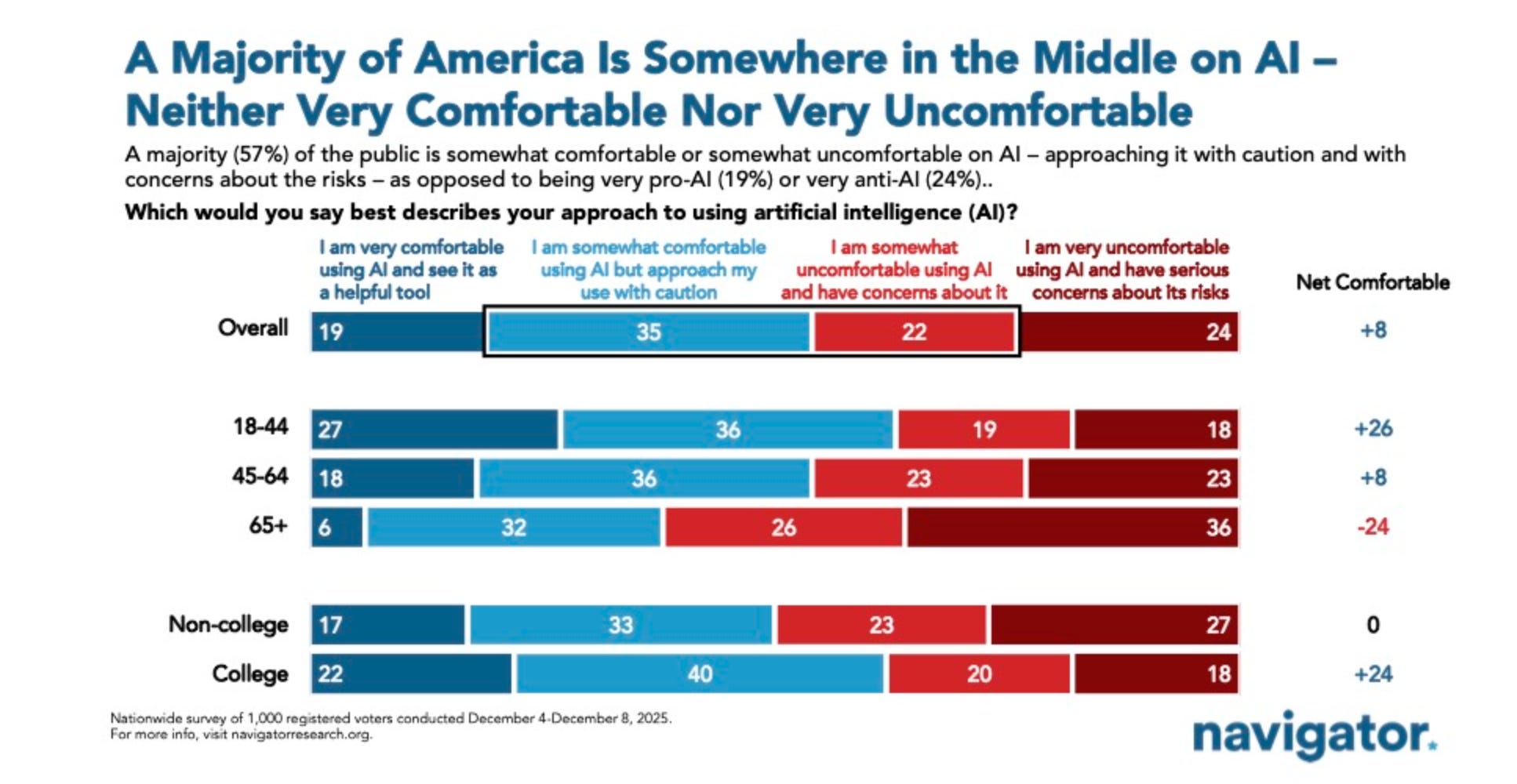
Can we really expect people to make the individual choice to opt out of AI’s benefits? We have the resources to design the rules and technology to improve our health and wealth, not worsen it.
I’d love to hear the questions on this topic you’d love answered.
Episode 1 explains where we are in the public conversation (along with sharing a smoothie recipe).
Episode 2 highlights the trend of state laws mandating the largest energy users (eg. tech companies) pay more for grid upgrades.
Episode 3 introduces the concept of data center flexibility, which would allow it to act as a virtual battery to strengthen the grid.
We also explained what the new EPA air pollution decision means for your health.
Follow “Solving the AI Power Problem” on YouTube, Instagram, and TikTok to learn more.
Culture Corner
This 16-min doc from MoMA on Ruth Asawa’s work is wonderful. She started her life as a farmworker and she drew from that close connection to nature for her countless artistic eras, from her iconic wire sculptures to drawings to kids art curriculum to paper sculptures.


Yes, hop onto the mass psychosis bus: Episodes 5 and 6 of HBO’s Heated Rivalry are incredibly fun television, and the memes are just as good. Come for the smut, stay for the heart. Here’s hoping someone does for climate what Heated Rivalry has done for queer representation and hockey.